ChatGPT patterns, practices, and prompts

5/5 - (4 votes)

ChatGPT and other generative AI tools definitely have a lot of capability, though getting them to do what you want (the way you want) can be a little challenging if you’re starting from scratch.

Fortunately, there are some patterns and frameworks that have been developed to help people structure their requests (or prompts, in the generative AI vernacular) in a way that gives the AI endpoint (ChatGPT, Bard, Claude, or whoever) the boundaries and guidelines necessary for great output.

Let’s get our assistant assisting!

How do I know how to ask?

There are several ways to explore this question. The best just might be to simply ask a tool like ChatGPT what you need to do to get the best results:
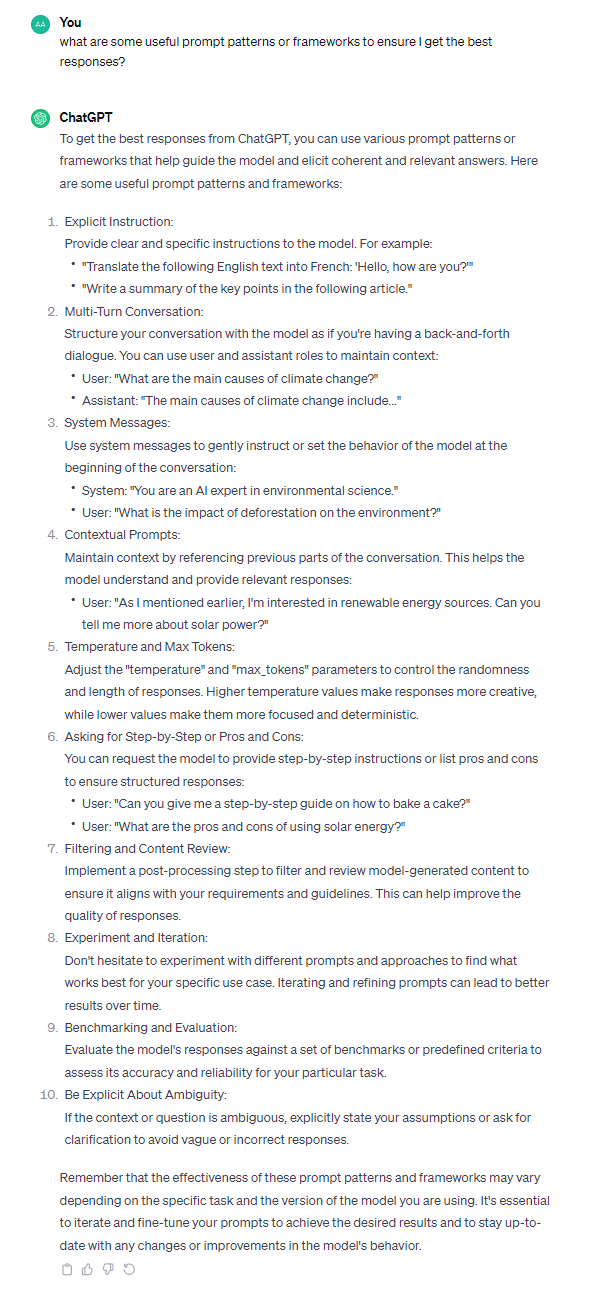
To get the best responses from ChatGPT, you can use various prompt patterns or frameworks that help guide the model and elicit coherent and relevant answers. Here are some useful prompt patterns and frameworks: 1. Explicit Instruction: Provide clear and specific instructions to the model. For example: - "Translate the following English text into French: 'Hello, how are you?'" - "Write a summary of the key points in the following article." 2. Multi-Turn Conversation: Structure your conversation with the model as if you're having a back-and-forth dialogue. You can use user and assistant roles to maintain context: - User: "What are the main causes of climate change?" - Assistant: "The main causes of climate change include..." 3. System Messages: Use system messages to gently instruct or set the behavior of the model at the beginning of the conversation: - System: "You are an AI expert in environmental science." - User: "What is the impact of deforestation on the environment?" 4. Contextual Prompts: Maintain context by referencing previous parts of the conversation. This helps the model understand and provide relevant responses: - User: "As I mentioned earlier, I'm interested in renewable energy sources. Can you tell me more about solar power?" 5. Temperature and Max Tokens: Adjust the "temperature" and "max_tokens" parameters to control the randomness and length of responses. Higher temperature values make responses more creative, while lower values make them more focused and deterministic. 6. Asking for Step-by-Step or Pros and Cons: You can request the model to provide step-by-step instructions or list pros and cons to ensure structured responses: - User: "Can you give me a step-by-step guide on how to bake a cake?" - User: "What are the pros and cons of using solar energy?" 7. Filtering and Content Review: Implement a post-processing step to filter and review model-generated content to ensure it aligns with your requirements and guidelines. This can help improve the quality of responses. 8. Experiment and Iteration: Don't hesitate to experiment with different prompts and approaches to find what works best for your specific use case. Iterating and refining prompts can lead to better results over time. 9. Benchmarking and Evaluation: Evaluate the model's responses against a set of benchmarks or predefined criteria to assess its accuracy and reliability for your particular task. 10. Be Explicit About Ambiguity: If the context or question is ambiguous, explicitly state your assumptions or ask for clarification to avoid vague or incorrect responses. Remember that the effectiveness of these prompt patterns and frameworks may vary depending on the specific task and the version of the model you are using. It's essential to iterate and fine-tune your prompts to achieve the desired results and to stay up-to-date with any changes or improvements in the model's behavior.

Those are same fantastic tips, indeed. While refinement and conversational styles may help you get where you want eventually, it’s even better if you can be as specific as possible up front.

Through continuous experimentation, several defined prompt syntaxes or rubrics have been developed with simple acronyms that can really help you drive towards the best results.

In this series, we’ll explore some of the popular prompt patterns that I’ve found really useful. Each section will follow a pattern of introducing the prompt syntax or framework, giving an example of a prompt that doesn’t use the prompt format, and then reimagining the prompt with the format.

Off we go!

BAB (Before-After-Bridge)

This simple syntax concept is to use a concise, specific problem statement combined with a goal and instruction. BAB has its roots in traditional copywriting and has worked for decades. The idea is simple–highlight a problem, tease a future where the problem is solved, and insert your product or service as the solution to get the customer there.

BAB can easily be adapted to designing great prompts.

The rubric is divided into three parts:

  • Define the BEFORE state or give a problem statement.
  • Define the AFTER state or the desired outcome.
  • Instruct the assistant to give you a BRIDGE or a path forward.

Without the prompt

For example, let’s say you have a website that isn’t doing well in search rankings. The first interaction is a pretty vanilla prompt and typical of one that someone might enter when trying to figure out how to improve search ranking.
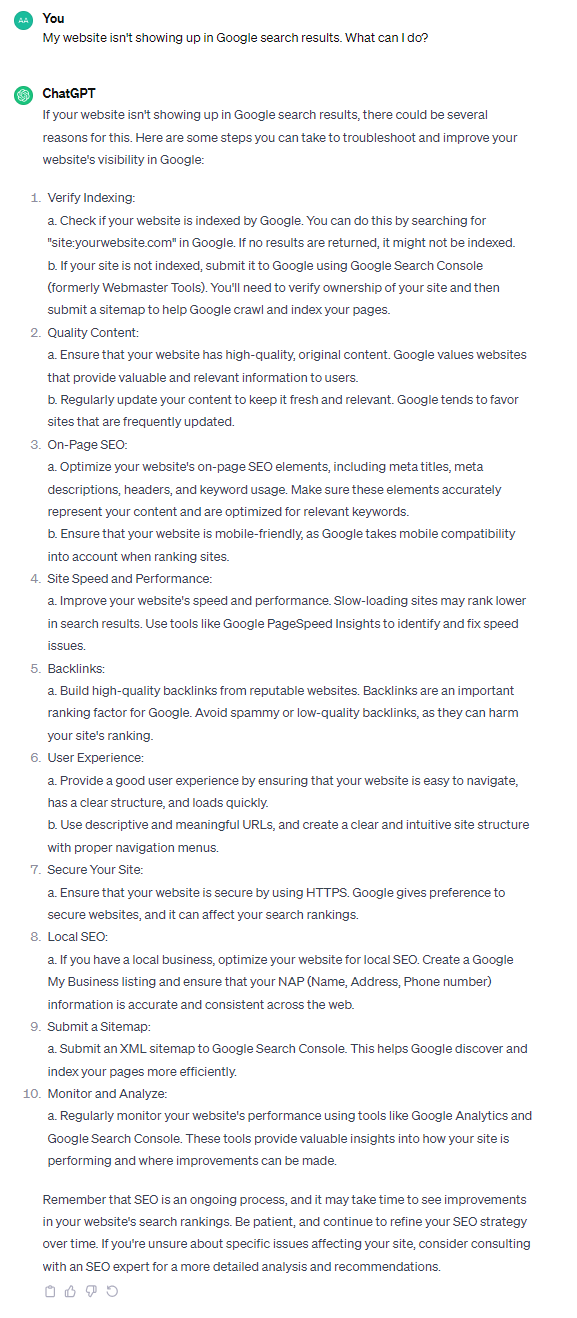
If your website isn't showing up in Google search results, there could be several reasons for this. Here are some steps you can take to troubleshoot and improve your website's visibility in Google: 1. Verify Indexing: a. Check if your website is indexed by Google. You can do this by searching for "site:yourwebsite.com" in Google. If no results are returned, it might not be indexed. b. If your site is not indexed, submit it to Google using Google Search Console (formerly Webmaster Tools). You'll need to verify ownership of your site and then submit a sitemap to help Google crawl and index your pages. 2. Quality Content: a. Ensure that your website has high-quality, original content. Google values websites that provide valuable and relevant information to users. b. Regularly update your content to keep it fresh and relevant. Google tends to favor sites that are frequently updated. 3. On-Page SEO: a. Optimize your website's on-page SEO elements, including meta titles, meta descriptions, headers, and keyword usage. Make sure these elements accurately represent your content and are optimized for relevant keywords. b. Ensure that your website is mobile-friendly, as Google takes mobile compatibility into account when ranking sites. 4. Site Speed and Performance: a. Improve your website's speed and performance. Slow-loading sites may rank lower in search results. Use tools like Google PageSpeed Insights to identify and fix speed issues. 5. Backlinks: a. Build high-quality backlinks from reputable websites. Backlinks are an important ranking factor for Google. Avoid spammy or low-quality backlinks, as they can harm your site's ranking. 6. User Experience: a. Provide a good user experience by ensuring that your website is easy to navigate, has a clear structure, and loads quickly. b. Use descriptive and meaningful URLs, and create a clear and intuitive site structure with proper navigation menus. 7. Secure Your Site: a. Ensure that your website is secure by using HTTPS. Google gives preference to secure websites, and it can affect your search rankings. 8. Local SEO: a. If you have a local business, optimize your website for local SEO. Create a Google My Business listing and ensure that your NAP (Name, Address, Phone number) information is accurate and consistent across the web. 9. Submit a Sitemap: a. Submit an XML sitemap to Google Search Console. This helps Google discover and index your pages more efficiently. 10. Monitor and Analyze: a. Regularly monitor your website's performance using tools like Google Analytics and Google Search Console. These tools provide valuable insights into how your site is performing and where improvements can be made. Remember that SEO is an ongoing process, and it may take time to see improvements in your website's search rankings. Be patient, and continue to refine your SEO strategy over time. If you're unsure about specific issues affecting your site, consider consulting with an SEO expert for a more detailed analysis and recommendations.

The result is decent and fundamentally sound, also pretty broad and vanilla. Sure, those are all really good ideas, but they’re not really actionable the way they’re written. Of course, not being specific with the exact problem or the exact area led ChatGPT to respond without specificity as well.

With the BAB prompt

Let’s follow the pattern and reframe this interaction with a specific scenario or problem statement, followed by a desired outcome and ending with a specific instruction to provide detailed steps.
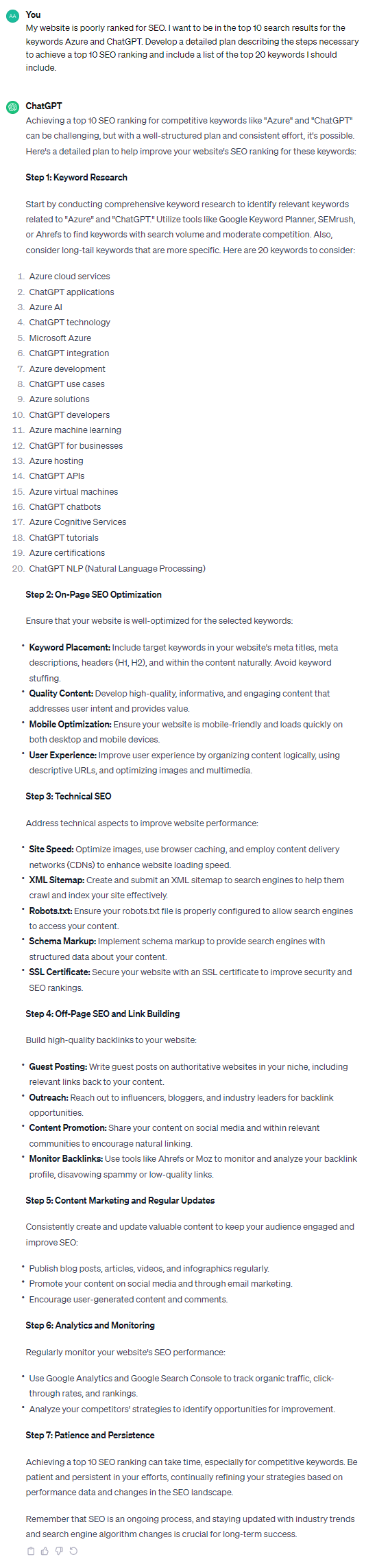
Achieving a top 10 SEO ranking for competitive keywords like "Azure" and "ChatGPT" can be challenging, but with a well-structured plan and consistent effort, it's possible. Here's a detailed plan to help improve your website's SEO ranking for these keywords: **Step 1: Keyword Research** Start by conducting comprehensive keyword research to identify relevant keywords related to "Azure" and "ChatGPT." Utilize tools like Google Keyword Planner, SEMrush, or Ahrefs to find keywords with search volume and moderate competition. Also, consider long-tail keywords that are more specific. Here are 20 keywords to consider: 1. Azure cloud services 2. ChatGPT applications 3. Azure AI 4. ChatGPT technology 5. Microsoft Azure 6. ChatGPT integration 7. Azure development 8. ChatGPT use cases 9. Azure solutions 10. ChatGPT developers 11. Azure machine learning 12. ChatGPT for businesses 13. Azure hosting 14. ChatGPT APIs 15. Azure virtual machines 16. ChatGPT chatbots 17. Azure Cognitive Services 18. ChatGPT tutorials 19. Azure certifications 20. ChatGPT NLP (Natural Language Processing) **Step 2: On-Page SEO Optimization** Ensure that your website is well-optimized for the selected keywords: - **Keyword Placement:** Include target keywords in your website's meta titles, meta descriptions, headers (H1, H2), and within the content naturally. Avoid keyword stuffing. - **Quality Content:** Develop high-quality, informative, and engaging content that addresses user intent and provides value. - **Mobile Optimization:** Ensure your website is mobile-friendly and loads quickly on both desktop and mobile devices. - **User Experience:** Improve user experience by organizing content logically, using descriptive URLs, and optimizing images and multimedia. **Step 3: Technical SEO** Address technical aspects to improve website performance: - **Site Speed:** Optimize images, use browser caching, and employ content delivery networks (CDNs) to enhance website loading speed. - **XML Sitemap:** Create and submit an XML sitemap to search engines to help them crawl and index your site effectively. - **Robots.txt:** Ensure your robots.txt file is properly configured to allow search engines to access your content. - **Schema Markup:** Implement schema markup to provide search engines with structured data about your content. - **SSL Certificate:** Secure your website with an SSL certificate to improve security and SEO rankings. **Step 4: Off-Page SEO and Link Building** Build high-quality backlinks to your website: - **Guest Posting:** Write guest posts on authoritative websites in your niche, including relevant links back to your content. - **Outreach:** Reach out to influencers, bloggers, and industry leaders for backlink opportunities. - **Content Promotion:** Share your content on social media and within relevant communities to encourage natural linking. - **Monitor Backlinks:** Use tools like Ahrefs or Moz to monitor and analyze your backlink profile, disavowing spammy or low-quality links. **Step 5: Content Marketing and Regular Updates** Consistently create and update valuable content to keep your audience engaged and improve SEO: - Publish blog posts, articles, videos, and infographics regularly. - Promote your content on social media and through email marketing. - Encourage user-generated content and comments. **Step 6: Analytics and Monitoring** Regularly monitor your website's SEO performance: - Use Google Analytics and Google Search Console to track organic traffic, click-through rates, and rankings. - Analyze your competitors' strategies to identify opportunities for improvement. **Step 7: Patience and Persistence** Achieving a top 10 SEO ranking can take time, especially for competitive keywords. Be patient and persistent in your efforts, continually refining your strategies based on performance data and changes in the SEO landscape. Remember that SEO is an ongoing process, and staying updated with industry trends and search engine algorithm changes is crucial for long-term success.

Much better! You can obviously further refine this. Some of the suggestions don’t have step-by-step detail, but you could push the model further and ask for expanded detail. You might try prompts like “How do I use Google Analytics to track organic traffic?” or “What are a website’s meta headers? Give an example of an SEO-optimized meta header using my keywords.”

RTF (Role-Task-Format)

In this prompt syntax, you’ll specify the role you want the AI assistant to impersonate, and then provide an instruction to perform and an explanation of how you want it to be formatted or presented.

This syntax has three core parts:

  • Assign the assistant a ROLE
  • Provide a TASK
  • Specify an output FORMAT

Without the prompt

As before, we’ll ask ChatGPT for an answer using just natural language without any framework.
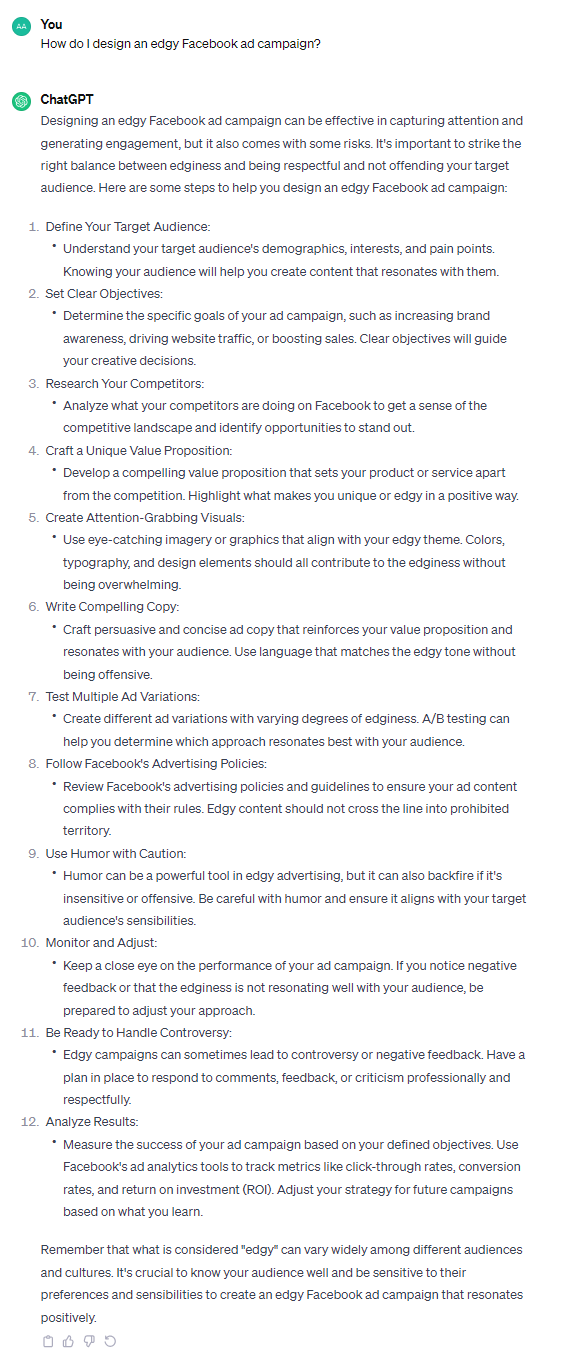
Designing an edgy Facebook ad campaign can be effective in capturing attention and generating engagement, but it also comes with some risks. It's important to strike the right balance between edginess and being respectful and not offending your target audience. Here are some steps to help you design an edgy Facebook ad campaign: 1. Define Your Target Audience: - Understand your target audience's demographics, interests, and pain points. Knowing your audience will help you create content that resonates with them. 2. Set Clear Objectives: - Determine the specific goals of your ad campaign, such as increasing brand awareness, driving website traffic, or boosting sales. Clear objectives will guide your creative decisions. 3. Research Your Competitors: - Analyze what your competitors are doing on Facebook to get a sense of the competitive landscape and identify opportunities to stand out. 4. Craft a Unique Value Proposition: - Develop a compelling value proposition that sets your product or service apart from the competition. Highlight what makes you unique or edgy in a positive way. 5. Create Attention-Grabbing Visuals: - Use eye-catching imagery or graphics that align with your edgy theme. Colors, typography, and design elements should all contribute to the edginess without being overwhelming. 6. Write Compelling Copy: - Craft persuasive and concise ad copy that reinforces your value proposition and resonates with your audience. Use language that matches the edgy tone without being offensive. 7. Test Multiple Ad Variations: - Create different ad variations with varying degrees of edginess. A/B testing can help you determine which approach resonates best with your audience. 8. Follow Facebook's Advertising Policies: - Review Facebook's advertising policies and guidelines to ensure your ad content complies with their rules. Edgy content should not cross the line into prohibited territory. 9. Use Humor with Caution: - Humor can be a powerful tool in edgy advertising, but it can also backfire if it's insensitive or offensive. Be careful with humor and ensure it aligns with your target audience's sensibilities. 10. Monitor and Adjust: - Keep a close eye on the performance of your ad campaign. If you notice negative feedback or that the edginess is not resonating well with your audience, be prepared to adjust your approach. 11. Be Ready to Handle Controversy: - Edgy campaigns can sometimes lead to controversy or negative feedback. Have a plan in place to respond to comments, feedback, or criticism professionally and respectfully. 12. Analyze Results: - Measure the success of your ad campaign based on your defined objectives. Use Facebook's ad analytics tools to track metrics like click-through rates, conversion rates, and return on investment (ROI). Adjust your strategy for future campaigns based on what you learn. Remember that what is considered "edgy" can vary widely among different audiences and cultures. It's crucial to know your audience well and be sensitive to their preferences and sensibilities to create an edgy Facebook ad campaign that resonates positively.

That’s a nice overview, but it lacks the detail necessary to make it actionable.

With the RTF prompt

Now, let’s try again use the RTF prompt format (as this is a GPT-4 prompt with an image, it can’t be shared yet):

Creating an edgy Facebook ad campaign for a new brand of underwear for an athleisure clothing brand involves several steps, including conceptualizing the storyboard, designing ad creatives, writing sample ad copy, and outlining an audience targeting strategy. Here's a conceptual storyboard for your campaign: ### 1. Ad Creative: The Bold Introduction - **Visual**: A dynamic, high-energy image featuring a diverse group of athletes wearing the underwear, engaged in various athletic activities. The setting is urban, with a gritty, modern vibe. - **Ad Copy**: "Redefine Comfort. Elevate Performance. Introducing [Brand Name] – where style meets endurance." - **Target Audience**: Young adults aged 18-35 who are fitness enthusiasts and value both style and comfort in their athletic wear. ### 2. Ad Creative: Focus on Comfort and Technology - **Visual**: Close-up shots of the underwear, emphasizing the fabric quality, waistband, and unique features like sweat-wicking technology. Background should be minimalistic to keep the focus on the product. - **Ad Copy**: "Engineered for Comfort. Designed for the Everyday Athlete. Feel the difference with [Brand Name]." - **Target Audience**: Health and fitness-focused individuals who are interested in the technical aspects of their workout gear. ### 3. Ad Creative: Lifestyle Integration - **Visual**: Lifestyle images showing people wearing the underwear in various everyday settings – at home, at the gym, out for a jog in the city. - **Ad Copy**: "From Sunrise Workouts to Sunset Hangouts. [Brand Name] fits your life." - **Target Audience**: Consumers who lead an active lifestyle and seek versatile clothing that fits both their workout and casual needs. ### 4. Ad Creative: Customer Testimonials - **Visual**: A collage of user-generated content, featuring real customers wearing the underwear in their daily routines. - **Ad Copy**: "Join the [Brand Name] Movement. Loved by Athletes. Trusted by You." - **Target Audience**: Social media-savvy individuals who value community opinions and real-world endorsements. ### 5. Ad Creative: Call to Action - **Visual**: A striking, attention-grabbing image of the product with a bold, limited-time offer (e.g., a discount code). - **Ad Copy**: "Dive into Comfort. Grab your exclusive offer now! Use code FIRST10." - **Target Audience**: Deal-seekers and first-time buyers who are incentivized by promotions. ### Audience Targeting Strategy: - **Primary Demographics**: Adults aged 18-35, interested in fitness, sports, and a healthy lifestyle. - **Interests and Behaviors**: Target users who follow fitness influencers, are members of health and wellness groups, and engage with other athleisure brands. - **Geographical Targeting**: Focus on urban areas with a high concentration of gyms and fitness centers. - **Retargeting**: Use pixel data to retarget users who visited the website but didn't make a purchase. ### Analytics and Optimization: - Regularly monitor engagement rates, click-through rates, and conversion rates. - Use A/B testing for different ad creatives to identify the most effective visuals and copies. - Adjust targeting parameters based on performance data and user feedback. This storyboard aims to establish a strong brand identity, showcase the product's unique features, and resonate with the target audience's lifestyle and preferences.

A lot more data that you can use–perhaps you could even feed some of those visuals back into ChatGPT (in this case, I used the GPT4 engine, which is also capable of producing images).
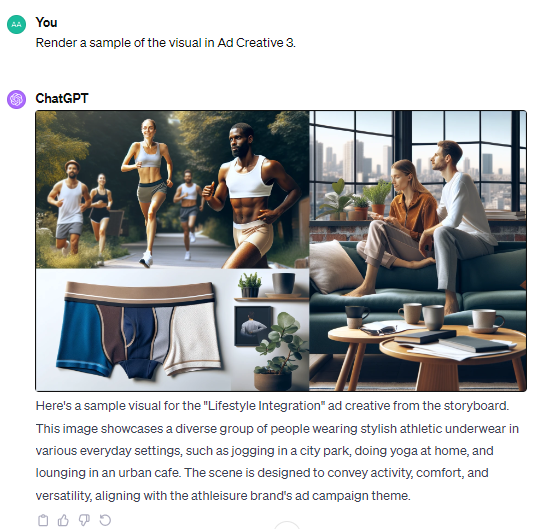
Here's a sample visual for the "Lifestyle Integration" ad creative from the storyboard. This image showcases a diverse group of people wearing stylish athletic underwear in various everyday settings, such as jogging in a city park, doing yoga at home, and lounging in an urban cafe. The scene is designed to convey activity, comfort, and versatility, aligning with the athleisure brand's ad campaign theme.

Obviously, not perfect (see the underwear with three leg holes), but it’s got some ideas that you can adapt or use as jumping off points for brainstorming.

PAS (Problem-Agitate-Solution)

Like BAB, PAS is a copywriting technique used to present a problem and solution. This time, however, there’s a twist: increasing the pressure. As a prompt framework for generating marketing copy, PAS can be helpful.

  • Describe the PROBLEM
  • Make the situation worse by AGITATING the consumer
  • Position the SOLUTION

Let’s give it a shot!

Without the prompt

In this example, pretend that you’re trying to write copy for a laundry detergent:

Introducing the Ultimate Stain Fighter: [Detergent Brand]! Tired of stubborn stains ruining your favorite clothes? Say goodbye to the hassle of pre-soaking and scrubbing. Our revolutionary laundry detergent is here to rescue your wardrobe! 🌟 Unleash the Power of Stain Elimination: Watch in awe as [Detergent Brand] effortlessly tackles even the toughest stains – from red wine spills to grass stains and everything in between. No more hiding your stained clothes at the back of your closet! 🌼 Gentle on Fabrics, Tough on Stains: Our advanced formula is specially designed to be gentle on your clothes while aggressively battling stains. Keep your fabrics vibrant and fresh, wash after wash. 💧 Superior Deep Cleaning: Experience the clean you've always dreamed of. [Detergent Brand] penetrates deep into fabric fibers, dissolving stains at their core. Your clothes will thank you for the spa treatment! 🌞 Freshness that Lasts: Not only does our detergent conquer stains, but it also leaves your laundry smelling as fresh as a spring morning. Say hello to long-lasting fragrance that lingers on your clothes. 🌿 Environmentally Friendly: We care about our planet. Our eco-friendly formula ensures that you're not just doing laundry; you're making a responsible choice for Mother Earth. 🛒 Try [Detergent Brand] Today! Don't let stains dictate your style. Elevate your laundry game with [Detergent Brand]. Say hello to a world of spotless, fresh, and vibrant clothes. Grab your bottle today and start living stain-free! [Call to Action Button]: Shop Now and Experience the Difference! [Website URL]: Visit us at www.exampledetergent.com Revitalize your wardrobe – one load at a time! #StainFreeLiving #LaundryMagic #CleanClothesForever

It’s kind of boring, just like laundry detergent normally is. It’s not exceedingly compelling.

With the PAS prompt

Now, let’s create a longer prompt that uses the PAS framework:
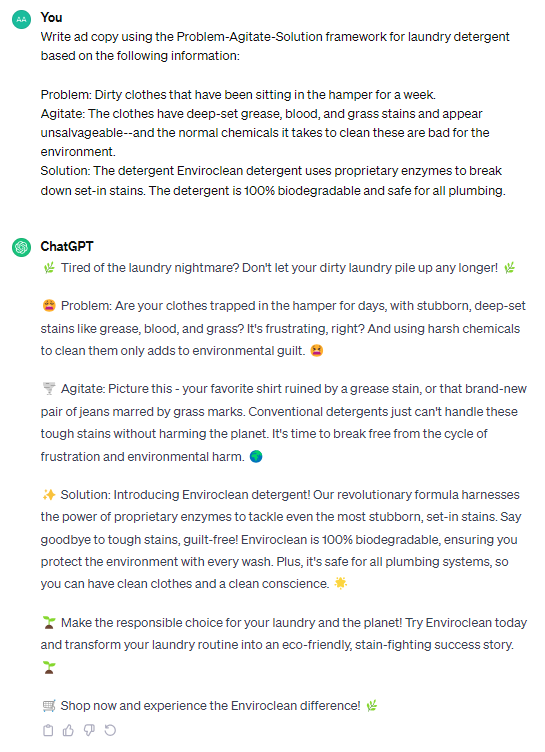
If you don’t think generated data is creative enough, you can tell the model to modify the temperature.  In terms of ChatGPT, temperature measures creativity, on a scale of .1 (your accountant) to 1.0 (Weird Al on shrooms).
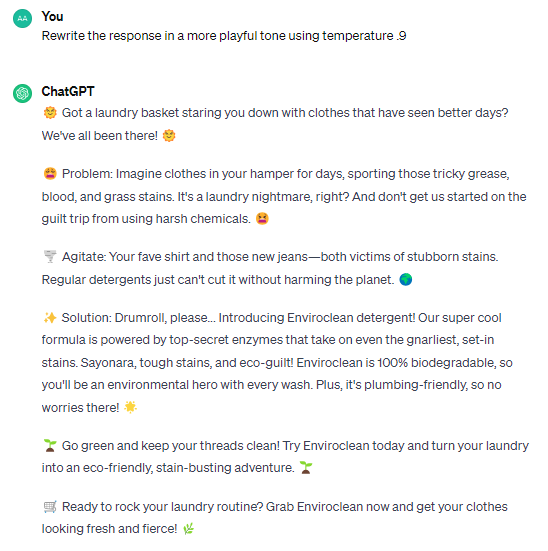
Rewrite the response in a more playful tone using temperature .9 ChatGPT 🌞 Got a laundry basket staring you down with clothes that have seen better days? We've all been there! 🌞 😩 Problem: Imagine clothes in your hamper for days, sporting those tricky grease, blood, and grass stains. It's a laundry nightmare, right? And don't get us started on the guilt trip from using harsh chemicals. 😫 🌪️ Agitate: Your fave shirt and those new jeans—both victims of stubborn stains. Regular detergents just can't cut it without harming the planet. 🌍 ✨ Solution: Drumroll, please... Introducing Enviroclean detergent! Our super cool formula is powered by top-secret enzymes that take on even the gnarliest, set-in stains. Sayonara, tough stains, and eco-guilt! Enviroclean is 100% biodegradable, so you'll be an environmental hero with every wash. Plus, it's plumbing-friendly, so no worries there! 🌟 🌱 Go green and keep your threads clean! Try Enviroclean today and turn your laundry into an eco-friendly, stain-busting adventure. 🌱 🛒 Ready to rock your laundry routine? Grab Enviroclean now and get your clothes looking fresh and fierce! 🌿

TAG (Task-Action-Goal)

The TAG rubric is another spin on the prompting. Like the BAB prompt, TAG has concepts that translate the thought, “how do we get there from here?”

  • Define a job or TASK
  • State the ACTION
  • Clarify and refine the GOAL

Without the prompt

In this example, we’ll ask for help improving customer service scores.
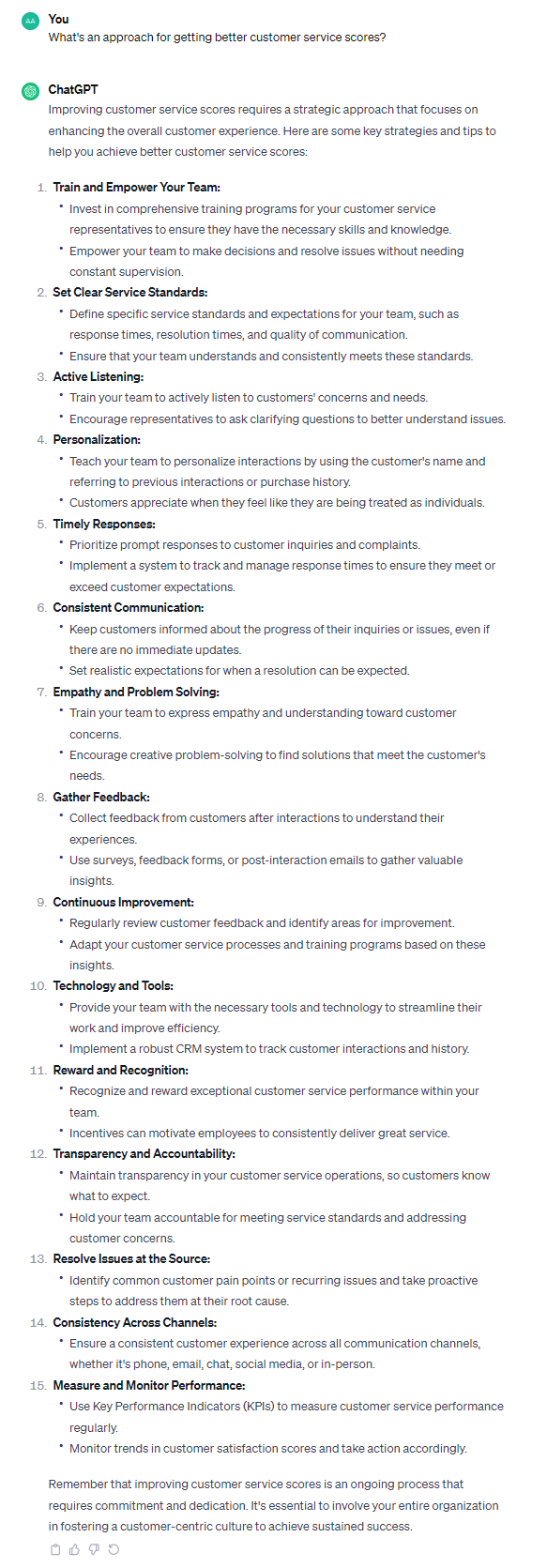
Improving customer service scores requires a strategic approach that focuses on enhancing the overall customer experience. Here are some key strategies and tips to help you achieve better customer service scores: 1. **Train and Empower Your Team:** - Invest in comprehensive training programs for your customer service representatives to ensure they have the necessary skills and knowledge. - Empower your team to make decisions and resolve issues without needing constant supervision. 2. **Set Clear Service Standards:** - Define specific service standards and expectations for your team, such as response times, resolution times, and quality of communication. - Ensure that your team understands and consistently meets these standards. 3. **Active Listening:** - Train your team to actively listen to customers' concerns and needs. - Encourage representatives to ask clarifying questions to better understand issues. 4. **Personalization:** - Teach your team to personalize interactions by using the customer's name and referring to previous interactions or purchase history. - Customers appreciate when they feel like they are being treated as individuals. 5. **Timely Responses:** - Prioritize prompt responses to customer inquiries and complaints. - Implement a system to track and manage response times to ensure they meet or exceed customer expectations. 6. **Consistent Communication:** - Keep customers informed about the progress of their inquiries or issues, even if there are no immediate updates. - Set realistic expectations for when a resolution can be expected. 7. **Empathy and Problem Solving:** - Train your team to express empathy and understanding toward customer concerns. - Encourage creative problem-solving to find solutions that meet the customer's needs. 8. **Gather Feedback:** - Collect feedback from customers after interactions to understand their experiences. - Use surveys, feedback forms, or post-interaction emails to gather valuable insights. 9. **Continuous Improvement:** - Regularly review customer feedback and identify areas for improvement. - Adapt your customer service processes and training programs based on these insights. 10. **Technology and Tools:** - Provide your team with the necessary tools and technology to streamline their work and improve efficiency. - Implement a robust CRM system to track customer interactions and history. 11. **Reward and Recognition:** - Recognize and reward exceptional customer service performance within your team. - Incentives can motivate employees to consistently deliver great service. 12. **Transparency and Accountability:** - Maintain transparency in your customer service operations, so customers know what to expect. - Hold your team accountable for meeting service standards and addressing customer concerns. 13. **Resolve Issues at the Source:** - Identify common customer pain points or recurring issues and take proactive steps to address them at their root cause. 14. **Consistency Across Channels:** - Ensure a consistent customer experience across all communication channels, whether it's phone, email, chat, social media, or in-person. 15. **Measure and Monitor Performance:** - Use Key Performance Indicators (KPIs) to measure customer service performance regularly. - Monitor trends in customer satisfaction scores and take action accordingly. Remember that improving customer service scores is an ongoing process that requires commitment and dedication. It's essential to involve your entire organization in fostering a customer-centric culture to achieve sustained success.

While these answers are indeed all good things that can be done to improve customer satisfaction scores, there isn’t a lot of detail. Most of these things are pretty obvious.

With the TAG prompt

We’ll rephrase the prompt using TAG, focusing on increasing the Net Promoter Score (NPS).
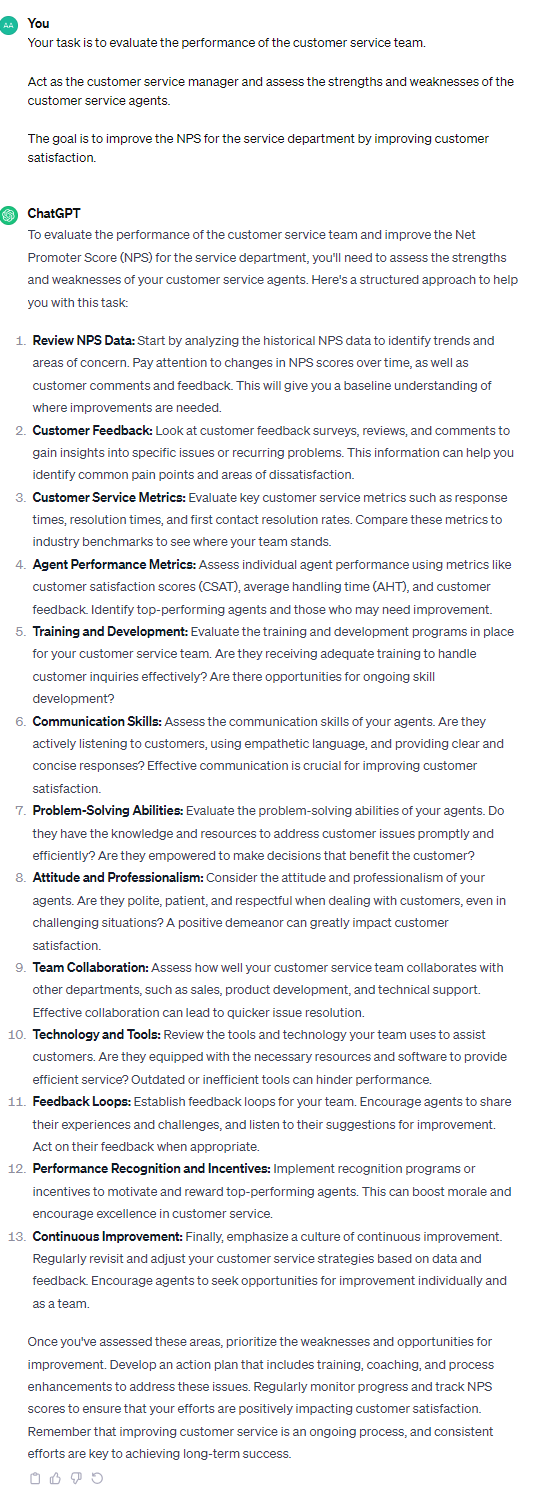
To evaluate the performance of the customer service team and improve the Net Promoter Score (NPS) for the service department, you'll need to assess the strengths and weaknesses of your customer service agents. Here's a structured approach to help you with this task: 1. **Review NPS Data:** Start by analyzing the historical NPS data to identify trends and areas of concern. Pay attention to changes in NPS scores over time, as well as customer comments and feedback. This will give you a baseline understanding of where improvements are needed. 2. **Customer Feedback:** Look at customer feedback surveys, reviews, and comments to gain insights into specific issues or recurring problems. This information can help you identify common pain points and areas of dissatisfaction. 3. **Customer Service Metrics:** Evaluate key customer service metrics such as response times, resolution times, and first contact resolution rates. Compare these metrics to industry benchmarks to see where your team stands. 4. **Agent Performance Metrics:** Assess individual agent performance using metrics like customer satisfaction scores (CSAT), average handling time (AHT), and customer feedback. Identify top-performing agents and those who may need improvement. 5. **Training and Development:** Evaluate the training and development programs in place for your customer service team. Are they receiving adequate training to handle customer inquiries effectively? Are there opportunities for ongoing skill development? 6. **Communication Skills:** Assess the communication skills of your agents. Are they actively listening to customers, using empathetic language, and providing clear and concise responses? Effective communication is crucial for improving customer satisfaction. 7. **Problem-Solving Abilities:** Evaluate the problem-solving abilities of your agents. Do they have the knowledge and resources to address customer issues promptly and efficiently? Are they empowered to make decisions that benefit the customer? 8. **Attitude and Professionalism:** Consider the attitude and professionalism of your agents. Are they polite, patient, and respectful when dealing with customers, even in challenging situations? A positive demeanor can greatly impact customer satisfaction. 9. **Team Collaboration:** Assess how well your customer service team collaborates with other departments, such as sales, product development, and technical support. Effective collaboration can lead to quicker issue resolution. 10. **Technology and Tools:** Review the tools and technology your team uses to assist customers. Are they equipped with the necessary resources and software to provide efficient service? Outdated or inefficient tools can hinder performance. 11. **Feedback Loops:** Establish feedback loops for your team. Encourage agents to share their experiences and challenges, and listen to their suggestions for improvement. Act on their feedback when appropriate. 12. **Performance Recognition and Incentives:** Implement recognition programs or incentives to motivate and reward top-performing agents. This can boost morale and encourage excellence in customer service. 13. **Continuous Improvement:** Finally, emphasize a culture of continuous improvement. Regularly revisit and adjust your customer service strategies based on data and feedback. Encourage agents to seek opportunities for improvement individually and as a team. Once you've assessed these areas, prioritize the weaknesses and opportunities for improvement. Develop an action plan that includes training, coaching, and process enhancements to address these issues. Regularly monitor progress and track NPS scores to ensure that your efforts are positively impacting customer satisfaction. Remember that improving customer service is an ongoing process, and consistent efforts are key to achieving long-term success.

Once again, using a more specific prompt syntax can help yield more specific results.

Happy prompting!

Series NavigationMore ChatGPT patterns, practices, and prompts >>