

This post picks up the trail and continues with more prompts and frameworks.
While I’d recommend going back to the previous post in this series to see where we started, it’s not required. In this post, we’ll continue exploring prompt rubrics or frameworks, giving examples on how to transform everyday questions into effective prompts.
Here we go!
CARE (Context-Action-Result-Example)
Humans learn best by personal experience. In AI-based scenarios, though, an AI platform isn’t going to be able to go out and have the experience of eating a sandwich or feeling the sun on its face. It can, however, learn by examples.
In the CARE prompt framework, you’re doing just that–providing the instructive context and guidelines and then providing an example of what a known good output looks like.
- Provide CONTEXT for the scenario
- Describe the task or ACTION the AI assistant should perform
- Clarify your expected RESULT or output
- Supply an EXAMPLE that shows the model what a suitable answer looks like
Without the prompt
In this example, we’ll ask the assistant to build a campaign for a pizza delivery company.
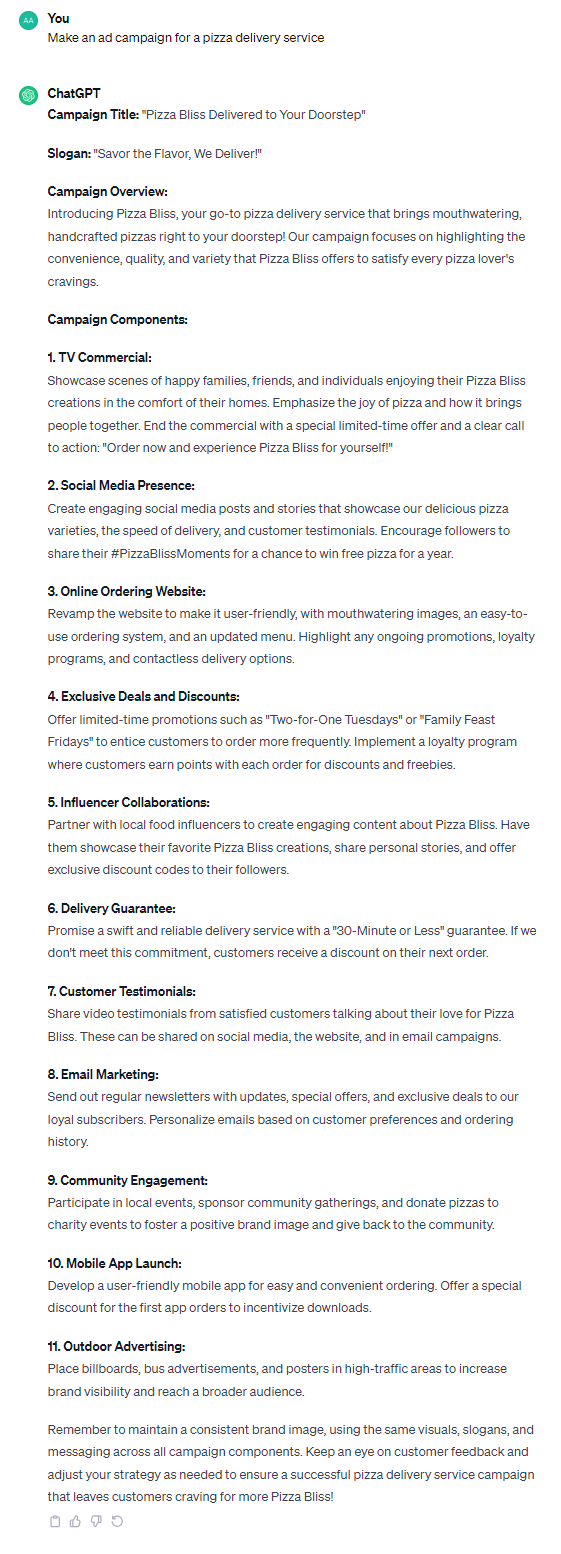
Not bad for 10 seconds of effort on my part. But what kind of results can we get with a better prompt?
With the CARE prompt
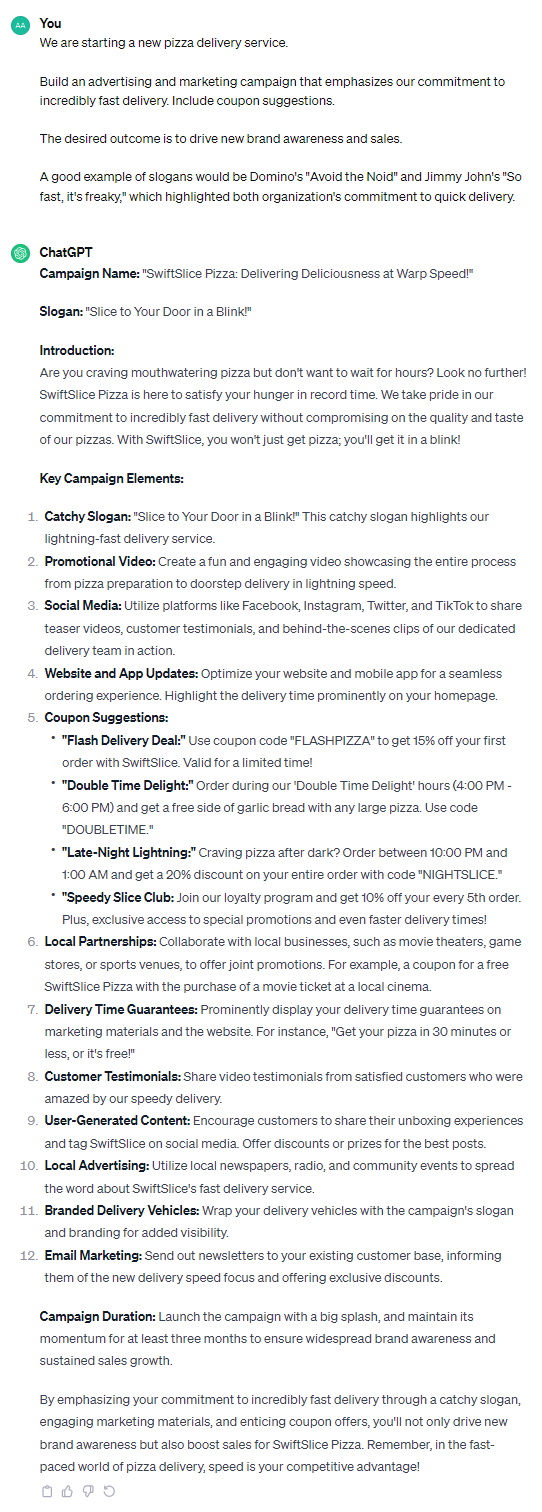
Suddenly, brand awareness. And in the distance–the ringing of cash registers.
STAR (Situation-Task-Action-Result)
Many folks might be familiar with this acronym in the context of job interviews. Frequently, in an interview scenario, a hiring manager is asking you to elaborate on a particular example as it relates to a question. For example, you might be asked, “Was there ever a time when you had to deal with a failed repair?” A suitable response would include a brief synopsis of the background (situation), the task you were expected to perform, the steps you took as part of the task, and what the outcome was.
This framework has a whole life outside of describing your experience to a potential employer.
The components of a STAR prompt are:
- Position a SITUATION or scenario
- Assign the model a TASK
- Provide additional or clarifying ACTION
- Define the qualities present in a the RESULT
Let’s see how it work!
Without the prompt
Suppose you are planning a family vacation. Without a prompt, your interaction with an AI assistant might go something like this:
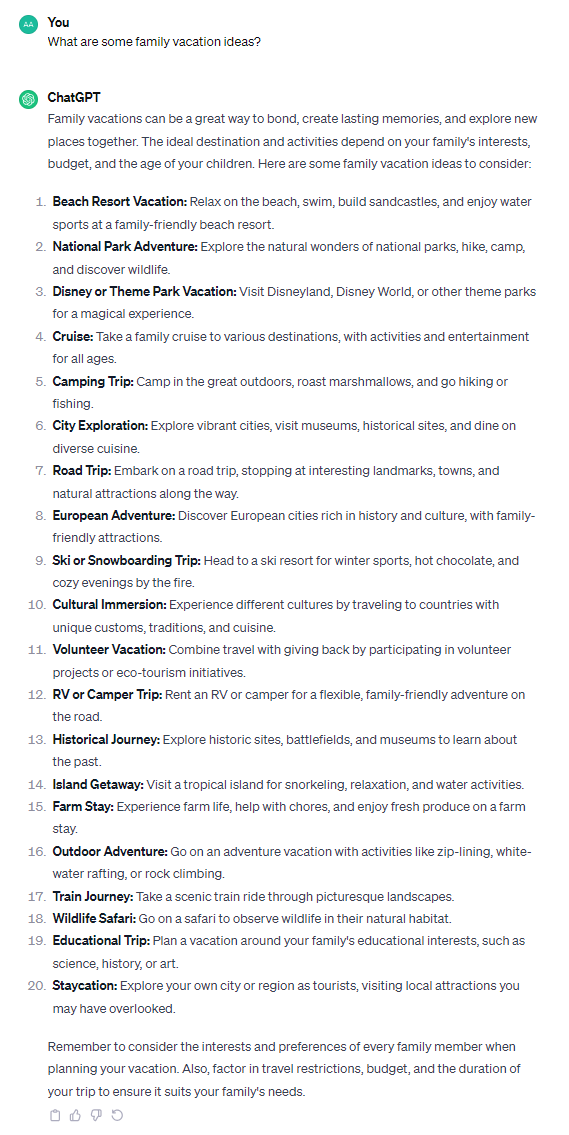
As with other examples in this series, the model can come up with some great answers (even with little input detail).
With the STAR prompt
Of course, now it’s time to see how a more specific prompt can be used to get a more detailed response.
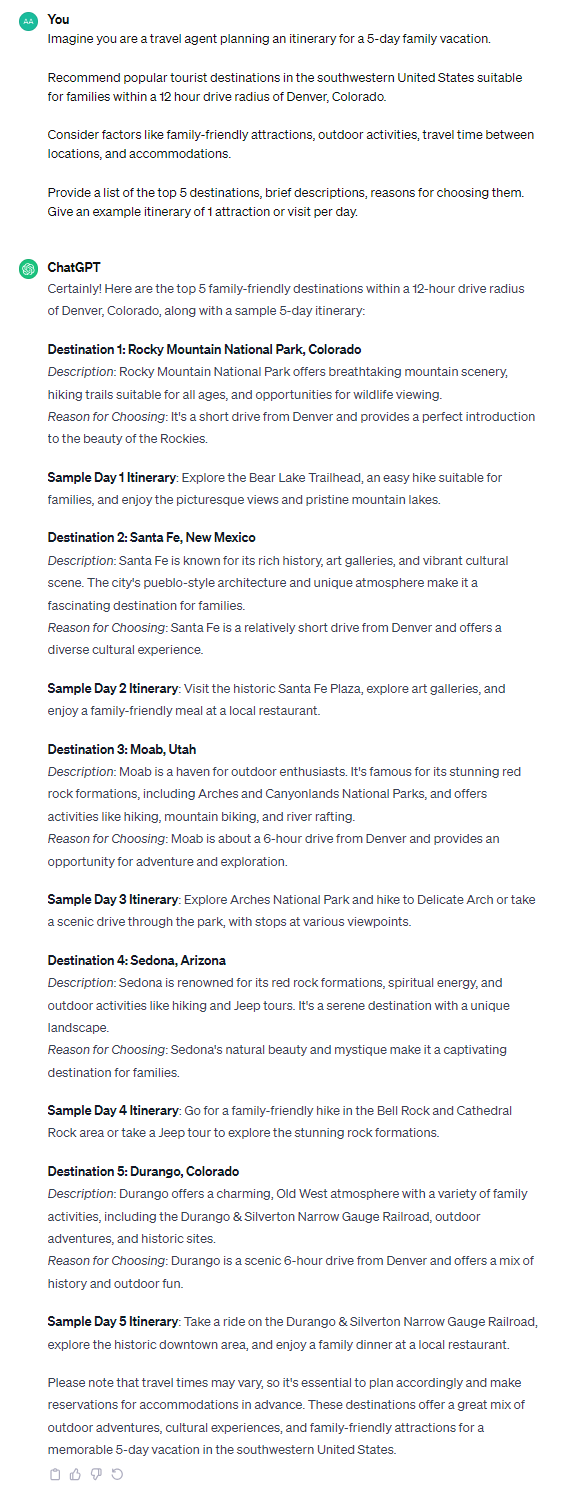
As you can see, providing a detailed list of results or expectations really pays off.
RISE (Role-Input-Steps-Expectation)
RISE is another framework that you can use and combines the role concept from other prompt constructs, the use of additional input detail or examples to set the context, and a request for a clear output with additional boundaries or guideposts in the form of expectations.
The RISE framework is comprised of the following elements:
- Frame the ROLE that the assistant should play
- Describe the background data to be used as INPUTS
- Ask the model for STEPS to complete a task
- Describe or define the goal or EXPECTATION of the output
Let’s say you’re working at an organization and you need to generate some ideas for a new subscription box service for cheese lovers.
Without the prompt
First, we’ll just ask a broad question about our nascent cheese subscription box without the framework, like we’ve done in the past:
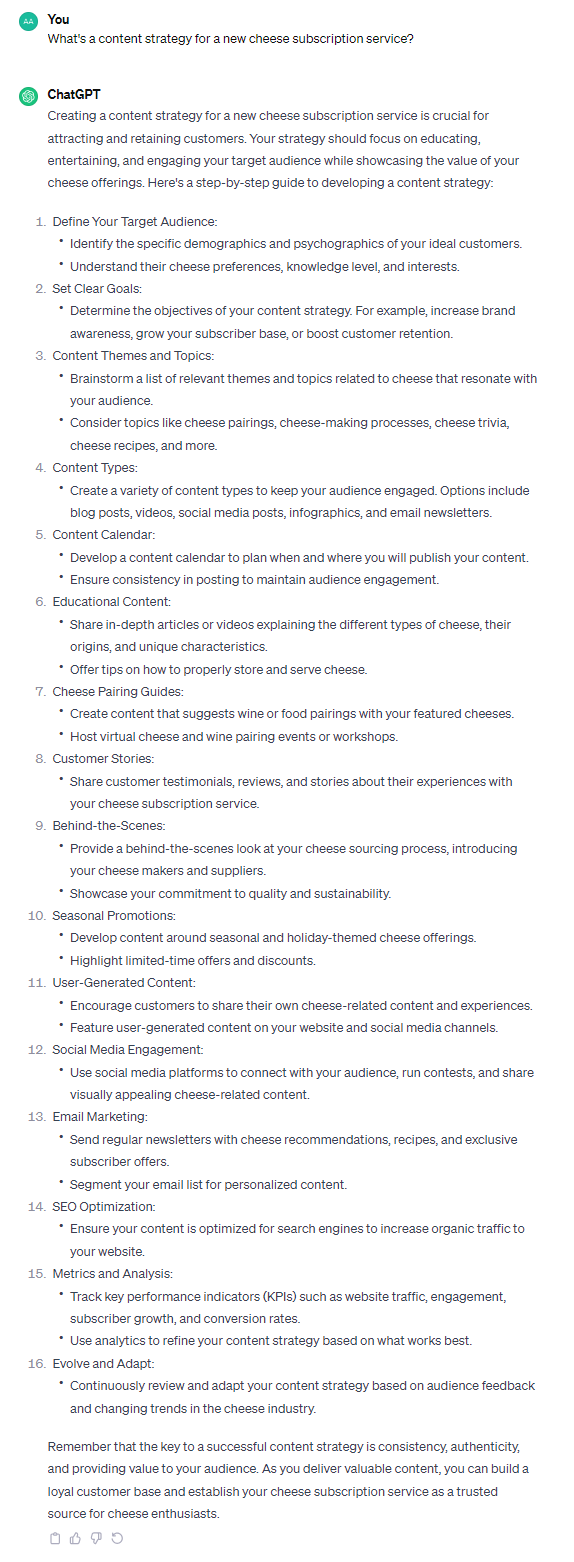
And, like a lot of the examples before, we’ve gotten a decent high-level strategy, but not anything specifically actionable.
With the RISE prompt
Next, we’ll adapt the prompt using the RISE method by supplying specific details about our target audience and potential questions, ending by instructing the assistant to create a few pieces of content:
![Content Strategy Plan for Cheese Subscription Box Service: **Step 1: Audience Research and Understanding** Before creating content, it's important to understand your audience. In this case, the target audience is people new to gourmet cheeses with potential questions and concerns. Gather insights through surveys, social media listening, and market research to better tailor your content. **Step 2: Create Engaging and Informative Blog Posts** Create blog posts that address common questions and concerns: **Editorial Calendar:** *Month 1: Introduction & Benefits* - Week 1: Blog post - "Welcome to the World of Gourmet Cheese: Our Cheese Subscription Box Service Unveiled" - Week 2: Blog post - "Why Gourmet Cheese Matters: A Journey into the World of Flavors" - Week 3: Blog post - "How to Pair Cheese with Wine, Crackers, and More" - Week 4: Blog post - "How Our Cheese Subscription Box Works: A Step-by-Step Guide" *Month 2: Quality and Assurance* - Week 1: Blog post - "Ensuring the Safety of Shipped Cheese: Our Packaging and Handling Process" - Week 2: Blog post - "How We Curate Cheese: From Selection to Your Doorstep" - Week 3: Blog post - "What Happens If You Don't Like a Cheese? Our Satisfaction Guarantee" - Week 4: Blog post - "Return Options and Getting a Different Cheese: Your Options Explained" *Month 3: Gifting and Trial* - Week 1: Blog post - "Gifting Gourmet Cheese: A Perfect Present for Cheese Lovers" - Week 2: Blog post - "How to Send a Cheese Subscription Box as a Gift: Step-by-Step" - Week 3: Blog post - "Free Trial: Experience Our Cheese Subscription Box Risk-Free!" - Week 4: Blog post - "Customer Reviews: Hear What Others Are Saying About Our Service" **Step 3: Social Media and Email Marketing** Promote each blog post on your social media channels and through email newsletters. Use engaging visuals, testimonials, and special offers (e.g., free trial) to entice potential subscribers. **Step 4: Customer Support Content** Create an FAQ section on your website that addresses these common questions in detail. Link to these FAQs in your blog posts to provide readers with more information. **Step 5: Collaborations and Guest Posts** Consider collaborating with cheese experts, chefs, or food bloggers to create guest posts. These can add credibility and variety to your content. **Step 6: Video Content** Produce short video clips showcasing unboxing experiences, cheese pairing tips, and behind-the-scenes looks at your curation process. Share these on social media and your website. **Step 7: Engaging Introductory Letter for Blog Post** [Blog Post Title: Welcome to the World of Gourmet Cheese: Our Cheese Subscription Box Service Unveiled] Dear Cheese Enthusiasts, Are you ready to embark on a journey through the delicious world of gourmet cheeses? We're thrilled to introduce you to our brand-new Cheese Subscription Box service, designed especially for those new to the exquisite world of fine cheeses. Cheese has a magical ability to transport your taste buds to new heights, and we're here to guide you on this delightful adventure. Whether you're just starting to explore the world of artisanal cheeses or looking for a convenient way to indulge your passion, our subscription box is tailor-made for you. Here's a taste of what you can expect: - Carefully curated selections of premium cheeses from around the world. - Expertly crafted pairings, from wine and crackers to fruits and preserves. - Assurance of the safety of your shipped food items through our rigorous packaging and handling process. - A satisfaction guarantee – if you don't love a cheese, we'll make it right! - Hassle-free return options and the chance to try a different cheese. - The opportunity to send the gift of gourmet cheese to a friend or loved one. - And yes, we even offer a free trial to get you started on your cheesy adventure! In the coming months, we'll be delving deeper into each aspect of our service, answering your burning questions, and sharing insights into the world of cheese. Whether you're a complete novice or a seasoned cheese aficionado, there's something for everyone in our subscription boxes. Stay tuned for more exciting updates, cheese pairings, and exclusive offers. Don't miss out on the chance to elevate your cheese experience with us. Subscribe today and join us in celebrating the joy of gourmet cheeses. Cheesily yours, [Your Name] Content Strategist, Cheese Subscription Box Service This introductory letter sets the tone for your content strategy and captures the essence of your subscription service's benefits, encouraging readers to explore and subscribe to your cheese subscription box.](https://www.undocumented-features.com/wp-content/uploads/2023/12/2023-12-13_17.png)
That’s a pretty stellar response (as someone who loves cheese, I am totally on-board with this cheese subscription box)!
Other ideas
Generative AI is a brave new world. So far, there aren’t any hard-and-fast rules about getting the exact responses you want each time. There’s a certain degree of randomness that comes into play. Just like asking 10 different people the same question can result in 12 answers, AI-based assistants are pretty similar.
I’ll recap some of my learnings over the last year or so here:
- There’s no definite right way to do this. It’s new.
- Feel free to mix and match prompt frameworks. You might get an idea using one framework that you really like–parlay it into a new prompt framework to help refine it!
- Another idea is to start with a broad, general prompt to start the creative process. Then, take some of the key thoughts in a conversational style and start drilling down into them.
- As you refine your ideas, provide more detailed guidance and specifics. You’ll get closer to the answers you’re looking for.
As the old saying goes, “unspecific data in, unspecific data out.”